

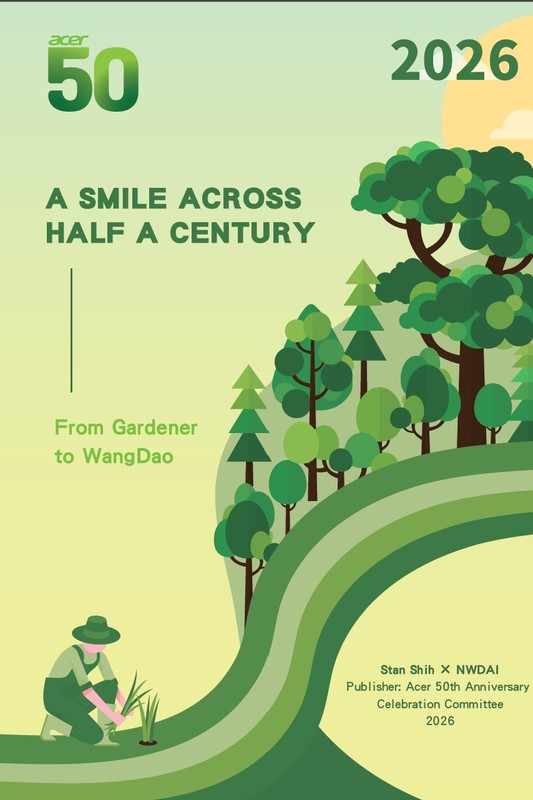
A Smile Across Half A Century (2026)
https://drive.google.com/file/d/1jS3KoV2o_H0HHaeICvec15sQ2tvSQ24J/view
New WangDao - The Leader’s Way for the 21st Century (2026)
https://drive.google.com/file/d/1n0FBSRCyTRz_v8omnPgLj854taAOeU66/view
*Introduction: Human society in the 21st century is facing unprecedented challenges, including the rise of AI, geopolitical restructuring, climate change, population aging, and the growing imbalance of global capitalism. Traditional industrial-era management models, centered primarily on efficiency and competition, are becoming insufficient to address the world’s increasing demand for sustainability, trust, shared prosperity, and long-term value creation.
In response to these challenges, New WangDao is proposed as a leadership philosophy for the 21st century, integrating Eastern philosophical wisdom, modern management science, sustainable development principles, and human-centered values for the AI era.
At its core, New WangDao emphasizes three fundamental beliefs:
Creating Value, Balancing Interests, and Sustainable Development.
It advocates that true leadership should not merely pursue short-term profits, but continuously create long-term total value for society.
New WangDao further introduces a “Total Value Thinking” framework, which emphasizes not only visible and measurable values, but also invisible and long-term values such as brand, talent, culture, trust, ecosystem, and social impact — factors that ultimately determine enduring competitiveness and sustainability.
Facing the transformation of global civilization in the AI era, New WangDao advocates that technology must be balanced with humanity, efficiency with values, and development with sustainability. New WangDao is not merely a management philosophy, but a new civilization-oriented leadership framework for the future.
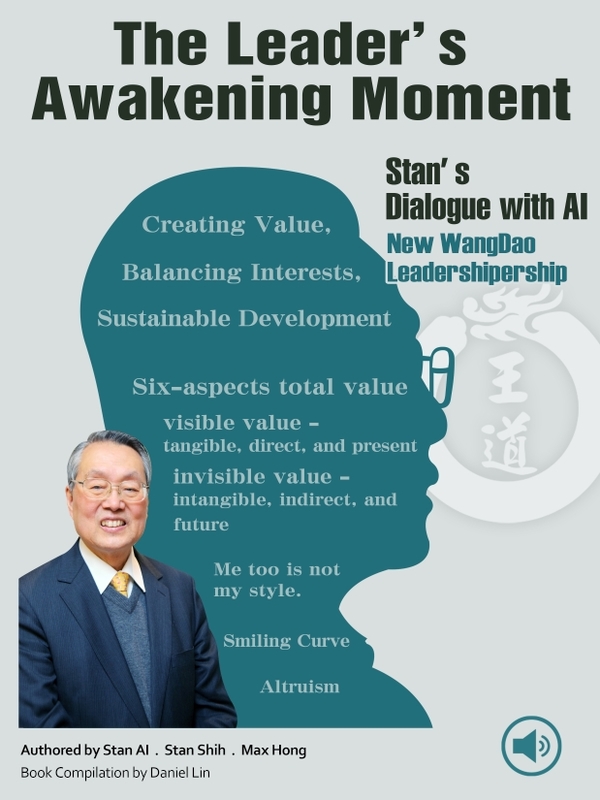
The Leader’s Awakening Moment:Stan’s Dialogue with AI (2025)
https://portal.eread.com.tw/Wangdao
*Introduction:
Preface| AI, Opening Another Door for Me
Chapter 1| The Beginning of Dialogue: AI, Do You Really Understand Me?
Chapter 2| From Information to Insight: How AI Helps Me Clarify My Thoughts
Chapter 3| AI Is Not a Tool, but a “Cognitive Assistant”
Chapter 4| Building an AI Culture and Environment in Enterprises
Chapter 5| AI × Wangdao: Translating and Spreading Culture
Chapter 6| Dialogue AI × The Making of a Decision-Making Avatar
Chapter 7| AI × Wangdao: A Grassroots Revolution of Organizational Co-Creation
Chapter 8| From Taiwan’s Experimental Field to the Global Wave: A New Generational Awakening of Wangdao Leadership
Dialogue with AI|
【Stan|A Record of Personal Philosophical Exploration】
— Conversations between Stan and AI Ruoyu《Complete transcript》
Afterword|
• Stan Shih: Creating Value and Contributing While Standing on the Shoulders of Giants
• Max Hung: The Next Wave: How Leaders Can Dance with AI
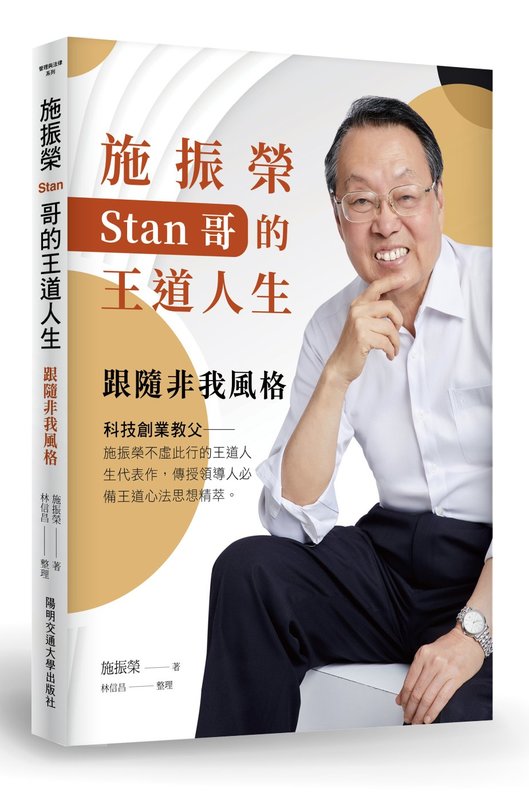
Stan Shih's Wangdao Life (2024)
https://drive.google.com/file/d/1CVQquUghhvYhUrzzakE-bzCs1XFUTHF3/view?usp=drive_link
*Introduction:
This book shares Stan's journey of practicing the Wangdao philosophy throughout Stan's entrepreneurial path and explores the long-term impact of applying Wangdao principles across various fields, offering further insights to readers.
The New Wangdao is founded on three core beliefs: creating value, balancing interests, and sustainable development. Only by continuously innovating to create value and building a mechanism that enables value co-creation and relative balance of interests can we achieve the ultimate goal of sustainable development.
Wangdao emphasizes that value creation should be viewed from six aspects, considering the total value of all things. Beyond the "tangible, direct, and present" visible value, it is crucial to focus on the "intangible, indirect, and future" invisible value. While visible value may be more immediately apparent, invisible value often yields greater and more enduring influence.
The book is structured around five perspectives: "Innovative Mindset," "The Smile Curve and Wangdao Thinking," " Know Wangdao, Practice Wangdao," "Industry Strategies and Policy Recommendations," and "Taiwan’s New Future." With Wangdao as its foundation, the book aims to expand leaders' horizons and thinking, guiding enterprises and organizations toward the goal of sustainability.

Acer’s Experience and Taiwan’s Electronics Industry
- The Reminiscences of Stan Shih (2018)
https://drive.google.com/file/d/1WJ0gQj3wmQVAzDRkXFfn5DuFLcFDUGtZ/view?usp=drive_link
*Introduction:
Chapter 1. 1960-1980: The Birth of Acer
Chapter 2. The 1990s: Challenge of Globalization
Chapter 3. 2000-2010: Committed to Brand Development
Chapter 4. After 2010: Transformation of the Cloud Age
Chapter 5. Thoughts on the Future of Taiwan Industry: Stan’s Views
Appendix. Theory and Reality: Analysis of Acer’s Business Management Model

Wangdao for New Era (2015)
https://drive.google.com/file/d/1-XIGj9QFrxbAgH7WIlRPQKoW2SzYMzoG/view?usp=drive_link
*Introduction:
Based on 40 years of corporate leadership, Mr. Shih has developed the Wangdao management system. This book helps the reader rise above existing ways of thinking and pave the way to leadership success in an organization. It is the discipline for extraordinary leaders of the new era.
If the corporate management model of the west is a method, then, Wangdao is an ambicultural method that melds both eastern and western thought. This world needs a new business strategy that lets everyone co-create value and break down the dominating thoughts of “winner-take-all” and “the rich and poor imbalance.”
This book elucidates the altruistic methodology of value co-creation evaluated based on Mr. Shih’s hexa-aspect value general theory. In addition, it includes tips for breakthrough leaders to innovate, grow, succeed and stay competitive in a dynamic environment.

The Challenge of Asia's Stranded Tiger (2016)
https://drive.google.com/file/d/1Zjqt8aoMzsPLVss4L8nHlOkiezOzJjEe/view?usp=drive_link
*Introduction:
This book explores various issues in Taiwan; and examine for new breakthrough concepts and beliefs in different levels and territories (personal, society, government, corporations…etc.) How should the younger generation tackle various issues and solve different problems? It also encourages the younger generation to break through the hurdles and create their own value.
Mr. Shih summarizes forty years of his lifetime experience and shares 31 breakthrough key thoughts in a colloquial tone with the younger generation, with a hope for a better future for Taiwan.

Smile and Beat Your Own Path (2012)
https://drive.google.com/file/d/1Z-H6nMEJXKjgaw6dvSh225wvyrmSt5y2/view?usp=drive_link
*Introduction:
This book was first written and completed in Chinese in 2012, eight years after Stan’s retirement from Acer. Compared to the previous two English books, “Me too is not my style” in 1996, and “Millennium Transformation” in 2004, both aimed to share lessons and experiences in running an enterprise, the new book extends beyond industry and business management matters to include his life and business philosophy, and his values.
Stan wrote this book with the sustainability of Taiwan’s competitiveness in mind and hence with a “Taiwan perspective”. He hopes it will be a good reference to those who care about Taiwan’s future development, or who are at a similar stage of development or background as Taiwan, or are in the process of partnering with Taiwan companies.
“Stan Shih’s Smiling Curve” has been published for twenty years since Stan proposed the perspective in 1992. The applications expand across wide-ranging fields. It has proven to be useful for analyzing particular ecosystems in different industries to identify ways to create business models that offer the highest value. It is valuable for understanding business progress and strategic choices to establish the long-term development strategy of an industry or enterprise.

Millennium Transformation (2004)
https://drive.google.com/file/d/117NwswfvYcjgXud0OCfz_bYlkm_jJbHC/view?usp=drive_link
*Introduction:
Written in 2004, “Millennium Transformation” documented the key turning-points of Acer from 1996 to 2004. A major focus is on 2000, when the author instigated the company’s second re-engineering by splitting the manufacturing/research and branding/service businesses. The author shares his experiences, through the principles of “Change Management”, and explains the background of the transition, as well as the processes of decision-making.
This book illustrated, in the Second Re-engineering, how Acer adjusted the organization and re-distributed company resources, based on three main principles: Simple, Focused, and Forward-Looking. Many important subjects of business operation are investigated in-depth, including The Brand-Value Formula, Acer Value Labs, MegaMicro e-Enabling Service, Human Resources Development, Corporate Culture, Finance Management, and Corporate Governance. Meanwhile, the well-known “Stan Shih’s Smiling Curve”was further explored.

Me too is not my style (1996)
https://drive.google.com/file/d/1nYUAGUUT-G1VrVBvvQJtPjyWyYsgxxOM/view?usp=drive_link
*Introduction:
Written in 1996, “Me too is not my style” recorded the process of development and many critical moments during the first twenty years of Acer, especially a corporate re-engineering movement initiated by the author in 1992. After the re-engineering, Acer once again operated with high effectiveness and competitiveness. To celebrate Acer’s 20th anniversary, Stan documented all these transition stories. He first published his concept of the “Smiling Curve” and many other new perspectives in this book.
The author would like to give the readers a complete image of the development of Taiwan high-tech industry, which went from nothing to playing a critical role in the global ICT supply chain. Meanwhile, the Acer Group, a well-known enterprise in Taiwan, continuously conquered its difficulties and created value to meet the dynamic change of the worldwide markets.